I've been a fisherman for a long time. I've stated before, that I started fishing at a very young age. When ever my family would be around a pond, lake or stream, I would be fishing! When you're young, the size of the fish doesn't really matter. It's the quanity that counts!
The Bluegill is the number one fish that most youngins like to catch.
While in school, I couldn't wait for spring break to get here! Usually, the weather had warmed enough to have melted the ice and I had all day to sit on the bank of our lake and fish!
I would dig up some worms, grab my fishing pole and away I would go. Nothing fancy, just a spincast rod, hooks, bobbers and worms! It was so much fun just watching and waiting for any sign of movement from the bobber!
I would generally, release the fish that I caught, until I got older and learned how to fillet the Bluegill. They are a very tasty fish, fun to catch and very plentiful in most bodies of water! This was all the fishing I needed to do at the time. When I became a teenager, my interests turned to Bass fishing and artificial baits. I love to cast for Bass but every once in a while, I still get the urge to put on a bobber and some worms for some old time fishing!
Today, I think most serious fisherman would laugh at the idea of sitting on the shore with bobbers and worms, but I will bet, it is the way they got started!
Some Saturday or Sunday, get the family together and head to you favorite fishing spot, and just for the fun of it, string up the old hook, bobber and worms and see how much you enjoy getting back to how it all started!
Fall Crappie
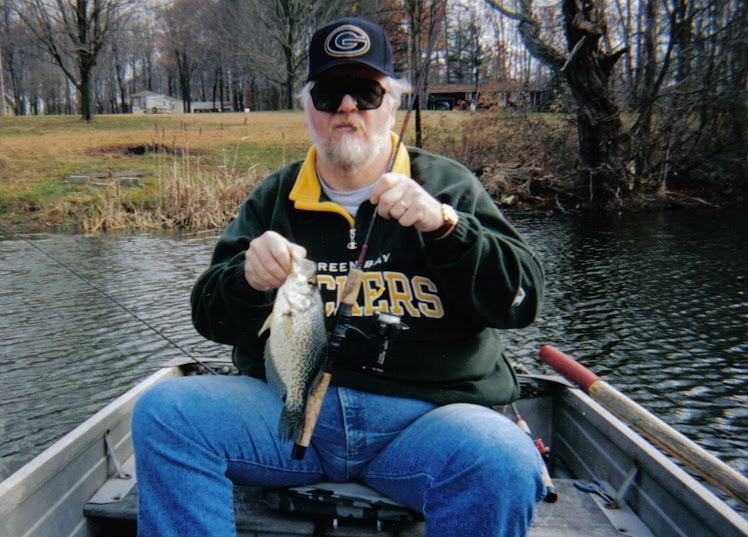
Me with a nice Black Crappie and Cigar
Late Summer Crappie
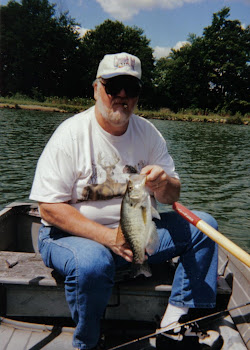
Me with a nice White crappie and Cigar
Tuesday, August 14, 2012

Saturday, July 28, 2012
I LOVE FISHING FOR LARGEMOUTH BASS
My passion for fishing is no secret! I grew up from age 3, knowing that there wasn't anything that I wanted to do, that I enjoyed as much as fishing!
Dad was my guiding force and I will forever be greatful to him for sharing this love with me!
Even though Dad taught me how to catch Bluegill through Northern Pike, my interest soon solidified on Largemouth Bass fishing!
I studied all the fishing techniques of the 60's and would practice these methods and learned how to modify them to fit my style!
It diffently helped to have grown up on a 12 acre lake and to have the opportunity to fish every day, weather permitting! This lake was, at one time, the best Bass fishing waters in our area and regularly gave up #3-#5 Bass plus an occasional #6+ fish! this lake really spoiled me and a couple of friends. It was an extreme rarity that we couldn't catch fish on this lake! It was very disappointing to travel to other waters and fish our hearts out but end up getting skunked!
As I got older, our family started traveling to Canada and upstate New York in search of both Smallmouth and Largemouth Bass as well as Walleye and Pike. We enjoyed some very good trips and a few that weren't so good! Our best year was in June 1971, at Black Lake New York. We had some fabulous fishing! Everyone caught Bass, Walleye and Pike. We limited out each day!
A technique that worked so well that summer was to wind drift over weed beds and drop black hair jigs through the openings in the weeds. We only used a length of line around the length of our rods. We would drop the jigs and follow them down, bounce them a couple of time, then lift and start over. One old timer, we talked with, called this "DAPPING". This worked on bright sunshiny days where a slight breeze could move your boat across the weed beds. The fish were just piled in under those weeds and we caught Bass, Walleye, large Crappie, Perch and Pike and an occasional Needlenose Gar. This technique will work anywhere!
Back in Ohio, I fished and caught Bass at a number of locations. Westville Lake in Northwestern Columbiana County is a favorite of mine. This lake is fished heavily on weekends but is very empty during the weekdays. This is an excellent Bass lake and is used by several area Bass Clubs for weekly and weekend tourneys.
There are a couple of State waters in my area but they are fished hard. It has been several years since I've fished either one but I have heard they have become fairly good Bass Lakes! The State of Ohio doesn't do anything to promote Bass fishing. They seem to be more interested in annual stockings of Saugers, Catfish and Trout!
I caught my first Bass over #6 in May of 1971 and since then I have been fortunate to have caught Bass up to #8. It is always a thrill to bring a beauty like that to the boat, lip it, unhook it, admire it then release it! The one thing I regret about my earlier fishing days is, I didn't release enough of the big Bass that I caught. These large fish are the brood fish of tomorrow, so with that said, enjoy every fish you catch and release the big ones!
Dad was my guiding force and I will forever be greatful to him for sharing this love with me!
Even though Dad taught me how to catch Bluegill through Northern Pike, my interest soon solidified on Largemouth Bass fishing!
I studied all the fishing techniques of the 60's and would practice these methods and learned how to modify them to fit my style!
It diffently helped to have grown up on a 12 acre lake and to have the opportunity to fish every day, weather permitting! This lake was, at one time, the best Bass fishing waters in our area and regularly gave up #3-#5 Bass plus an occasional #6+ fish! this lake really spoiled me and a couple of friends. It was an extreme rarity that we couldn't catch fish on this lake! It was very disappointing to travel to other waters and fish our hearts out but end up getting skunked!
As I got older, our family started traveling to Canada and upstate New York in search of both Smallmouth and Largemouth Bass as well as Walleye and Pike. We enjoyed some very good trips and a few that weren't so good! Our best year was in June 1971, at Black Lake New York. We had some fabulous fishing! Everyone caught Bass, Walleye and Pike. We limited out each day!
A technique that worked so well that summer was to wind drift over weed beds and drop black hair jigs through the openings in the weeds. We only used a length of line around the length of our rods. We would drop the jigs and follow them down, bounce them a couple of time, then lift and start over. One old timer, we talked with, called this "DAPPING". This worked on bright sunshiny days where a slight breeze could move your boat across the weed beds. The fish were just piled in under those weeds and we caught Bass, Walleye, large Crappie, Perch and Pike and an occasional Needlenose Gar. This technique will work anywhere!
Back in Ohio, I fished and caught Bass at a number of locations. Westville Lake in Northwestern Columbiana County is a favorite of mine. This lake is fished heavily on weekends but is very empty during the weekdays. This is an excellent Bass lake and is used by several area Bass Clubs for weekly and weekend tourneys.
There are a couple of State waters in my area but they are fished hard. It has been several years since I've fished either one but I have heard they have become fairly good Bass Lakes! The State of Ohio doesn't do anything to promote Bass fishing. They seem to be more interested in annual stockings of Saugers, Catfish and Trout!
I caught my first Bass over #6 in May of 1971 and since then I have been fortunate to have caught Bass up to #8. It is always a thrill to bring a beauty like that to the boat, lip it, unhook it, admire it then release it! The one thing I regret about my earlier fishing days is, I didn't release enough of the big Bass that I caught. These large fish are the brood fish of tomorrow, so with that said, enjoy every fish you catch and release the big ones!
Wednesday, July 18, 2012
I'VE BEEN AWAY FOR A LONG TIME!
I don't know how long this return may last! This past 1 1/2 years has taken it's toll on me! I suffered a small stroke in January 2011, which knocked the snot out of me! I was laid up for 4 months, not being able to see very well and my legs suffered the most with extreme weakness! I still have a very hard time maneuvering and have a tendency to trip and fall! Not much fun!
On July 23, 2011 we lost our youngest son at the age of 33! To this day we are not sure what killed him! After this incident, I basically just gave up! I lost interest in everything and just hung around the house!
I went fishing one time last summer and have yet to get out this year!
It's really hard to give up what has been my main interest in life but it's just not there for me anymore! I still feel the love for fishing but being disabled has taken a lot of the enjoyment away!
My wife bought me some new soft plastic grubs and worms for Easter, hoping I would attempt to give them a try, but they are still in a bag beside my easy chair!
I have one friend that I did most of my fishing with but he has found other interests this year and hasn't had the time for fishing!
All that said, let's try to get back to fishing.
This has been a very warm and dry summer. This has dropped the water levels and created difficulties launching boats in some waters. Mosquito reservior, up in Trumbull county, has three main ramp areas closed and I've heard there are new islands and sand bars showing that we could not see before! Even with the low water, Walleyes, Bass and large Catfish are still being caught. The Bass and Walleyes are around weed beds.
For Bass, try throwing buzz baits, spinner baits and crank baits around the weed beds,wood and rock formations. Walleyes are being caught trolling worm harnesses around weed beds in the deeper water.
I guess, if you can stand the heat, the fish are still hungry and can be caught! If you can, Catch a few for me but please, release the Bass!
On July 23, 2011 we lost our youngest son at the age of 33! To this day we are not sure what killed him! After this incident, I basically just gave up! I lost interest in everything and just hung around the house!
I went fishing one time last summer and have yet to get out this year!
It's really hard to give up what has been my main interest in life but it's just not there for me anymore! I still feel the love for fishing but being disabled has taken a lot of the enjoyment away!
My wife bought me some new soft plastic grubs and worms for Easter, hoping I would attempt to give them a try, but they are still in a bag beside my easy chair!
I have one friend that I did most of my fishing with but he has found other interests this year and hasn't had the time for fishing!
All that said, let's try to get back to fishing.
This has been a very warm and dry summer. This has dropped the water levels and created difficulties launching boats in some waters. Mosquito reservior, up in Trumbull county, has three main ramp areas closed and I've heard there are new islands and sand bars showing that we could not see before! Even with the low water, Walleyes, Bass and large Catfish are still being caught. The Bass and Walleyes are around weed beds.
For Bass, try throwing buzz baits, spinner baits and crank baits around the weed beds,wood and rock formations. Walleyes are being caught trolling worm harnesses around weed beds in the deeper water.
I guess, if you can stand the heat, the fish are still hungry and can be caught! If you can, Catch a few for me but please, release the Bass!
Friday, March 11, 2011
I WANT TO GO CRAPPIE FISHING
It has been a terrible winter for me! I've been sick and in and out of the hospital so much since New Years that the hospital staff knows me by sight! I'm still not back to where I should be but I'm working on it day after day!
It is approaching the middle of March, 2011, the weather is starting to play tricks on us by being sunny and warm one day then cold windy and wet the next, followed by more snow! I haven't even taken a drive to check on our area lakes to see if they are in ice-out condition
With the price of gasoline edging up to $4.00 per gallon, my wife says to save the gas for work so who knows how much I'll be fishing this spring!
I've been watching films, on the internet, of ice fishing and early spring Crappie fishing.The Crappie will be moving into channels, bays, and canals as we get more into spring. They are fairly easy to catch using minnows hung from under a bobber (preferably a stick style bobber because this style gives less resistance and is easier for the fish to pull under). Also try 1/32ounce jigs with plastic bodies or grubs or maribou. These can be worked under a bobber and bounced slowly back in. Crappie will shallow up as the water warms but even in this cold water in early spring Crappie can be found in 3ft.-5ft.water depths.
If any of you know Columbiana County here in Ohio, you probably know Guilford Lake. One of the best early season areas in this lake is in the bay next to the camp grounds. The road that passes over the lake is CountyRd # 411 and is know as Teegarden Rd. There is a culvert under the road that feeds to the pond on the other side of the road. This has been the favorite area of Crappie fishermen for generations!
It's time to put fresh line of 4# to 6# on those Crappie poles,grab your box of panfish jigs and go catch some good eating Crappie!
It is approaching the middle of March, 2011, the weather is starting to play tricks on us by being sunny and warm one day then cold windy and wet the next, followed by more snow! I haven't even taken a drive to check on our area lakes to see if they are in ice-out condition
With the price of gasoline edging up to $4.00 per gallon, my wife says to save the gas for work so who knows how much I'll be fishing this spring!
I've been watching films, on the internet, of ice fishing and early spring Crappie fishing.The Crappie will be moving into channels, bays, and canals as we get more into spring. They are fairly easy to catch using minnows hung from under a bobber (preferably a stick style bobber because this style gives less resistance and is easier for the fish to pull under). Also try 1/32ounce jigs with plastic bodies or grubs or maribou. These can be worked under a bobber and bounced slowly back in. Crappie will shallow up as the water warms but even in this cold water in early spring Crappie can be found in 3ft.-5ft.water depths.
If any of you know Columbiana County here in Ohio, you probably know Guilford Lake. One of the best early season areas in this lake is in the bay next to the camp grounds. The road that passes over the lake is CountyRd # 411 and is know as Teegarden Rd. There is a culvert under the road that feeds to the pond on the other side of the road. This has been the favorite area of Crappie fishermen for generations!
It's time to put fresh line of 4# to 6# on those Crappie poles,grab your box of panfish jigs and go catch some good eating Crappie!
Monday, December 6, 2010
FISHING THROUGH HARD WATER
The ice is forming on the ponds and lakes! It is the 6th of December, 2010 here in Northeastern Ohio, and by the looks of things, it could be a long and cold winter! This is good news for us ice fishermen! The lake that I fish is a 12 acre pond with the water depth a maximum of 10-12 feet. Once the ice has obtained a thickness of 4"-5" I can be fairly sure it is safe for me to venture out on! As mentioned in my last post, I will cautiously work my way to the areas I want to fish by "TESTING" the ice thickness with a spud bar. The areas I want to fish are the same places we caught fish right before ice up. My auger allows for an 8" diameter hole (Ohio regs call for nothing larger than 12") which has proven to be big enough for the fish I catch! When the hole is opened, I will take my ice jig and lower it to the bottom to get a general depth of the area. I usually start fishing about a foot off the bottom and will shallow up if no bites occur within a few minutes. My choice of bait is generally maggots on the end of a small pin-min type panfish jig. I will load 3-4 maggots then drop the jig through the hole. I use a very small bobber (just large enough to float the jig) and a small split shot about a foot above the jig. On deeper water, a bobber is rarely used and the jigs are allowed to suspend and be vertically worked while watching the line and the "very light" rod tip for signs of a bite. This area of the country offers a couple of larger lakes that hold Walleye but for the most part the fishing is for Bluegill, Crappie and Perch. It always seemed funny that Bluegill are usually a secondary fish when fishing open water but become the primary sought after fish through the ice! Most of the strategy for ice fishing is the same as open water fishing. If you don't find the fish at one spot, move to another or try a different color jig and as mentioned earlier, different water depths! Once the fish are located, they should be in abundance! Other baits that are commonly used are wax worms, minnows and spikes,which are a large maggot. Short rods are made for ice fishing and are adviced due to the fact that they are easier to use because they get you closer to the hole. My rods are no longer that 25"-30" and I have small reels attached with no heavier that 4 pound test mono. The newer flurocarbon line like Berkley's Vantage is great to use! The best advice I can give here is to have really warm boots that are water proof and insulated. There are all kinds of material used now for insulation but to be honest a cheap and effective material is the felt pack liner. For years all I had was a set of felt packs slipped into a pair of old buckle up rubber boots and these worked just fine! You might want to invest in ice spikes or cleats for the bottom of the boots. These really help on a slick ice surface and take it from me, when you slip and fall, hitting that ice is like hitting cement! I carry a plastic 5 gallon bucket that holds all my tackle when I'm moving around and then I use the bucket as a seat and to carry the fish back home! You can spend alot of money on equipment such as a power auger, fancy cold weather gear, sleds to haul your equipment and ice shanties or tents along with heaters and lights, or you can buy or make a good, sharp spud bar, have a decent pair of warm weather coveralls and boots, like I mentioned earlier, buy a cheap ice rod for under $15 and a few panfish jigs plus maggots and be set to go! For the doubters, it will be next to impossible to get them on the ice but for the ones who really enjoy the winter, it's a very interesting way to spent the day and hopefully take home some very good eating!
Tuesday, November 30, 2010
WINTER HARD WATER FISHING
Today is November 30, 2010. Although today's weather is above normal with rain, tomorrow is suppose to be near normal with snow showers. It's often said about the weather here in Ohio, "if you don't like the weather today, wait until tomorrow"! There has been some skim ice on the ponds already but it hasn't been cold enough to start a good ice over. I was checking the weather in Minnesota the other day and found the weather at Mille Lacs lake to be in the low twenties for day time highs and near "0" at night! This area usually ends up with over 3 foot of ice and their ice fishing season runs through March! If we get the right weather here in Ohio, I've seen our season run from mid January till mid February. It takes several nights with temperatures around zero to make good ice on our lakes. I refer to "Good Ice" as being hard and 6" or more in thickness! A rule of thumb states that 2" of ice can support one 200 pound man, 3" can support a small group that are spread out, 6" of hard ice will support a car. I mentioned "Hard Ice". If the freeze isn't interrupted by warming temperatures or rain and snow, the ice should form a hard, thick covering. If there is a period of snow during the freeze over, the ice will take on a cloudy, softer form and will require thicker ice to be safe! Personally, I never traverse on the ice until it is at least 5" thick. I'm a large guy at over 350 pounds and I don't like to take chances! When I think the time is right to check out the ice, I approach from the shallows, and using a spud bar, I attempt to see how solid the ice is by chopping small holes close to shore! If I'm happy with the results then I'll move further out and open another hole. I'll do this until I reach the first area I want to fish then I'll use my auger to open my fishing hole. I will use this method over the entire lake or at least the areas I will be fishing. The thickness of the ice can vary according to different underwater conditions or any structures like boat docks, rocks or wood that is protruding through the ice. These objects will draw heat from the sun and actually melt the ice that is surrounding them! You should never venture out on new ice alone. Keep in mind that the surface water is at 32 degrees and can be extremely life threating if you should break through! Ice fishing is a great sport and a fun way to make it through the long winter months. Use common sense, dress accordingly, have good equipment and you will find out just how much you will enjoy fishing through "Hard Water"!
Friday, November 19, 2010
THE LAST FISHING DAY OF 2010
Today was probably the last open water fishing day for 2010! We got out around 11a.m. and fished until 4p.m.. The day was sunny, breezy and COLD! The air temperature was 45 degrees, the wind out of the southwest at about 10 m.p.h. and the water temperature was around 43 degrees. Not the most perfect fishing day that we have enjoyed! We did, however, manage to catch 6 bass each for a total of 12 fish! My buddy caught all of his on spinners, using a C.P.Swing tipped with a yellow and white Uncle Josh Fly Strip and a chartreuse Rooster Tail. I used a black jig/plastic combo and a Smithwick Rogue jerk bait to lure my bass. The fish didn't seem to be on any pattern but were randomly scattered. Some came out of deep water while some came from the shallows. It was good to end the season on a high note since it's always good to catch bass and not get skunked on days like these! The small 12 foot boat is pulled from the water and turned over until spring, when we start the whole process over again! I've started making out my wish list for Christmas, wanting two new casting reels and rods to go with them, a new spinning outfit and maybe a new 9 foot fly rod with 7-8 weight line for bass fishing, plus several new fishing lures that are due out on the market soon! Over the winter, we will probably make a trip down to Wheeling, W.Va. to Cabala's and maybe one to Toledo, Ohio to Bass Pro Shops. I really need to get rid of some of my older tackle before I buy new but it is all like old friends to me and I don't know what to give up! It's hard for me to believe that my favorite casting rod is over 25 years old! We've had fun this fall with bass fishing and will be ready to get back to it come spring. I've yet to decide if ice fishing is in the cards, only time will tell! I'll let you all know so keep reading!
Friday, November 12, 2010
INDIAN SUMMER BASS
This week has been really beautiful here in Northeastern Ohio! The sun has been bright with temperatures in the low to mid 60's. While most folks are starting to think about the up coming holidays and trying to get all their last minute fall yard work done before the snows of December come, here we are, still catching Largemouth Bass! The weather these past two days (Nov.10 and 11) has been great and the fishing has been even better! The temperature has fell back into the low 30's at night but has rebounded into the low 60's during the day along with "Bluebird Skies"! My buddy and I have found some really good Bass this week. The one thing about fishing this time of year is when you find a fish you will find serveral in the same area! The weapons of choice has been Rapala Husky Jerks, Smithwick Rogues and CP Swings with a yellow and white Uncle Josh Fly Strip! The nice thing about using the smaller Husky Jerks is they can be worked really slow and since they are a suspending lure, they hover in the water when stopped! The water temperature was 46 degrees and the Bass didn't hit the baits very hard but instead would just "stop" the bait or hit while it was stopped and then it was the pure weight of the fish on the end of the line as they fought! Not keeping a count of the fish we caught, I would say in the two days we landed around 30 Bass, a dozen Bluegill and several "Jumbo" Yellow Perch that reached an amazing 12-14 inches in length! Being a small, private lake the only creatures we had to share the water with were about 180 Canadian Geese and 4-6 Mallard Ducks! It was very interesting to watch the geese as they kept their distance from us and at the approach of evening, they took off to find their supper. The geese were in the extreme upper end of the lake and reminded us of a squardron of aircraft when they took off! They divided into "Wings" of 6 groups and would swim into the middle of the upper end before going airborne. The group behind would wait until the group ahead was well into the air and clear of the take off area before they would jump off. The flights of geese were so perfectly timed with the lapse between flights that it made for very interesting viewing! It was two perfect days to be out on the water and with nature all around!
Saturday, October 23, 2010
CATCHING BASS ON A COLD AND WINDY OCTOBER DAY
Today is Saturday, October 23, 2010. My buddy Bill and I have spent the last two days on the lake in search of our favorite fish, Largemouth Bass. Yesterday started out very chilly with the temperature around 40 degrees at 10 o'clock in the morning. There was also a westerly breeze of between 10 and 15 mph. We got on the lake at 11 o'clock and fished until 5 o'clock in the afternoon. The fishing started out slow but picked up during the afternoon. We always say that we are going to count and keep track of the number of Bass we catch but never do! We found a good number of fish yesterday and the size was alittle above average which was a bonus! The Bass were hitting various lures from crank baits to spinner baits but for the most part they were caught on Rapalas and Smithwick Rogues. I thought the Bass would run into the shallows chasing the bait fish but they didn't.
Today's weather was an improvement from yesterday with the temperature getting into the low 60's but the wind was still there for a while and a heavy cloud cover moved in during the early afternoon. The fish weren't as agressive as yesterday but we still managed to catch our fair share. I also found some Black Crappie, Bluegill and serveral large Yellow Perch that would have made the perch fishermen of Lake Erie quite envious.
Today, we changed up our lure selection a little by using more straight in-line spinners which immitated small bait fish. We are hoping to give it another try next week and are starting to talk about taking a couple of trips next season and try our luck at other lakes. My mind actually started thinking about ice fishing which I haven't done in years. I'll have to tell you about some of those experience later on. If you can, leave me some comments or tails about your fall fishing. I can always talk fishing and enjoy hearing how other folks do it!
Today's weather was an improvement from yesterday with the temperature getting into the low 60's but the wind was still there for a while and a heavy cloud cover moved in during the early afternoon. The fish weren't as agressive as yesterday but we still managed to catch our fair share. I also found some Black Crappie, Bluegill and serveral large Yellow Perch that would have made the perch fishermen of Lake Erie quite envious.
Today, we changed up our lure selection a little by using more straight in-line spinners which immitated small bait fish. We are hoping to give it another try next week and are starting to talk about taking a couple of trips next season and try our luck at other lakes. My mind actually started thinking about ice fishing which I haven't done in years. I'll have to tell you about some of those experience later on. If you can, leave me some comments or tails about your fall fishing. I can always talk fishing and enjoy hearing how other folks do it!
Thursday, October 21, 2010
PICKING THE RIGHT TACKLE
These days, there is so much talk about picking the right fishing tackle, rods, reels, lines, baits,etc., that it can be quite confusing to the novice angler! If you ever watch some of the pro fishermen, they have so much tackle that I wonder how they keep from stepping all over it! You must kept in mind that since these people are pros they probably have all their tackle given to them, for endorsements and advertising purposes, from all the big name tackle manufacters.
For us every day anglers, things aren't always that easy for us to obtain the tackle that we would really like to have so, we must settle for less expensive rods and reels and instead of having a half dozen or more of each style rod, maybe we can only afford one or two!
By last count I had 4 casting reels and 6 casting rods, 6 spinning reels and 7 or 8 spinning rods, 4 fly rods and boxes full of lures, hooks and miscellaneous stuff and junk! Much of my tackle has seen better days and a couple of my outfits are over 40 years old! I'm not extremely protective of my things so I don't take very good care of my stuff. The simple fact that they are good pieces of equipment has allowed me to continue to use them today!
I haven't changed line on some of these reels for years, mainly due to the fact that there are only 3-4 outfits that I use on a regular basis. I do go over each and every outfit each spring and if I feel things need addressed, then at that time, I will do what is needed. Naturally, this is not the way to maintain your fishing tackle and I am advising you not to do what I do! You can look at the cost of tackle today as a major expense but one that will give you years of good service with the right up keep!
I look at new tackle every day, either by visits to the area stores or on-line, and I try to plan what I'm going to buy or replace next spring. I really need some new casting equipment since this is my primary rod and reel combination that I use for my Bass fishing. I want to purchase a 7 foot casting rod that has a fast to medium action and good for lure weights up to 3/4oz. I will team this with a high speed reel that has at least 6 ball bearings and 6.3:1 retrieve.
What I look for in new rods is #1) the feel of the rod. I don't want it to weight a ton because I might be casting this all day. #2) the recommended lure weights, which you will find on the lower end of the rod. #3) The action of the rod. A fast action rod will feel stiff through out the length of the rod with the exception of the rod tip. This will give the rod more backbone for horsing fish from cover. A medium action rod will have more of a bend from the tip into the mid portion of the rod. These will be better for crank baits fishing because of the give of the rod under the weight of a hooked fish. #4) I look at the number of guides on the rod. I actually think this may be the most important issue of all! The more the better and check to see the spacing of the guides are proportionally set down the length of the rod. Depending on a person's size should also be a key to determine the length of rod he or she will be comfortable using! A taller person will be more at ease casting a longer rod than someone with a shorter stature! The best length to start with is a 6 footer and work up from there. When a spinning rod is desired, all of the above should be taken into consideration. The average length of an all purpose spinning rod is a 6-7 foot rod. If an ultra light outfit is wanted, say to use for Bluegill and Crappie, a rod of light weight, limber body and length of 5-6 foot and a small reel with 4-6 pound test line is the way to go!
There are many styles and makes out there and everyone has their preference. I feel if my guide lines are considered, any rod will work just fine!
For us every day anglers, things aren't always that easy for us to obtain the tackle that we would really like to have so, we must settle for less expensive rods and reels and instead of having a half dozen or more of each style rod, maybe we can only afford one or two!
By last count I had 4 casting reels and 6 casting rods, 6 spinning reels and 7 or 8 spinning rods, 4 fly rods and boxes full of lures, hooks and miscellaneous stuff and junk! Much of my tackle has seen better days and a couple of my outfits are over 40 years old! I'm not extremely protective of my things so I don't take very good care of my stuff. The simple fact that they are good pieces of equipment has allowed me to continue to use them today!
I haven't changed line on some of these reels for years, mainly due to the fact that there are only 3-4 outfits that I use on a regular basis. I do go over each and every outfit each spring and if I feel things need addressed, then at that time, I will do what is needed. Naturally, this is not the way to maintain your fishing tackle and I am advising you not to do what I do! You can look at the cost of tackle today as a major expense but one that will give you years of good service with the right up keep!
I look at new tackle every day, either by visits to the area stores or on-line, and I try to plan what I'm going to buy or replace next spring. I really need some new casting equipment since this is my primary rod and reel combination that I use for my Bass fishing. I want to purchase a 7 foot casting rod that has a fast to medium action and good for lure weights up to 3/4oz. I will team this with a high speed reel that has at least 6 ball bearings and 6.3:1 retrieve.
What I look for in new rods is #1) the feel of the rod. I don't want it to weight a ton because I might be casting this all day. #2) the recommended lure weights, which you will find on the lower end of the rod. #3) The action of the rod. A fast action rod will feel stiff through out the length of the rod with the exception of the rod tip. This will give the rod more backbone for horsing fish from cover. A medium action rod will have more of a bend from the tip into the mid portion of the rod. These will be better for crank baits fishing because of the give of the rod under the weight of a hooked fish. #4) I look at the number of guides on the rod. I actually think this may be the most important issue of all! The more the better and check to see the spacing of the guides are proportionally set down the length of the rod. Depending on a person's size should also be a key to determine the length of rod he or she will be comfortable using! A taller person will be more at ease casting a longer rod than someone with a shorter stature! The best length to start with is a 6 footer and work up from there. When a spinning rod is desired, all of the above should be taken into consideration. The average length of an all purpose spinning rod is a 6-7 foot rod. If an ultra light outfit is wanted, say to use for Bluegill and Crappie, a rod of light weight, limber body and length of 5-6 foot and a small reel with 4-6 pound test line is the way to go!
There are many styles and makes out there and everyone has their preference. I feel if my guide lines are considered, any rod will work just fine!
Sunday, October 17, 2010
MY FAVORITE LAKE IN COLUMBIANA COUNTY
In my photos, the small lake that I am fishing is where I grew up. This is a 12-15 acre lake located in the north western portion of Columbiana County. I have been associated with this small body of water all of my life! My parents bought a partial of land here in 1947 for $500. Dad built our home on the property in 1961. Dad started fishing here in the mid 1940's and fell in love with the lake and decided to become an associate. The lake has always been private, open only to it's members however, during the 1960's it was opened for pay to fish to the public.
If I had a $1.00 for each fish I've caught out of this lake, I'd be a very wealthy man today! I've seldom gone there without catching fish and some of my friends, that have been with me, have said that this is the best water they have ever fished!
It was primarily a Largemouth Bass lake when Dad started fishing it but it also held Bluegill, Crappie, Perch, Catfish and a few Suckers (in the early days).
The lake is approximately over 170 years old, having been constructed as the result of the old Sandy and Beaver canal system that was attempted between 1835 and 1850. A branch of said canal runs northwest and southeast of the lake and the lake ( I believe) was constructed as a reservoir for the canal.
I would have loved to have been around at that time to have witnessed the construction. The lake has changed so much in my life time due to sediment filling in the shorelines. There used to be some major drop offs along the edges but the mud and muck has taken those away!
There used to be abundant lily pad growth and not much weeds but today it's just the opposite! The pads used to be so thick that half of the lake was covered with them and it looked like you could walk on them! The membership has always been fighting a never ending battle against the vegetation problems and today with the older members, I think it is a lost cause!
The majority of the members don't fish and cann't see the importance of a good lake management program! There are basically too many fish in the lake (since there are no fish being removed) and the size of the Bass have decreased through the years as a result! A thriving fish population is obtained through a good harvesting and catch and release program! For instance, if large Bass are the goal then the population of average size fish needs to be thinned out. The state of Ohio's D.N.R. recommends that 10 Bass under the length of 10 inches be removed per acre of fishing water plus one Bass of 15 inches every year. Then the primary food source, let's say Bluegill, should be reduced at the rate of 300 - 500 bluegill over the 6 inch size, per acre per year! This will allow the smaller Bluegill to be more readily available to be food fish for the Bass, allowing them to grow larger! That's a lot of fish for a 12 acre lake, especially when no one fishes the water!
Having said all the negative "stuff" about the lake, there is not a day that goes by that I don't want to be on that water! My buddy and I still manage to have a real good time and the Bass fishing is still good even if the fish are on the small side! I'm just as guilty for not taking fish but at the age of 60, I am just too lazy to clean them! We keep saying, "maybe today we will bring some home to eat", but never do!
If I had a $1.00 for each fish I've caught out of this lake, I'd be a very wealthy man today! I've seldom gone there without catching fish and some of my friends, that have been with me, have said that this is the best water they have ever fished!
It was primarily a Largemouth Bass lake when Dad started fishing it but it also held Bluegill, Crappie, Perch, Catfish and a few Suckers (in the early days).
The lake is approximately over 170 years old, having been constructed as the result of the old Sandy and Beaver canal system that was attempted between 1835 and 1850. A branch of said canal runs northwest and southeast of the lake and the lake ( I believe) was constructed as a reservoir for the canal.
I would have loved to have been around at that time to have witnessed the construction. The lake has changed so much in my life time due to sediment filling in the shorelines. There used to be some major drop offs along the edges but the mud and muck has taken those away!
There used to be abundant lily pad growth and not much weeds but today it's just the opposite! The pads used to be so thick that half of the lake was covered with them and it looked like you could walk on them! The membership has always been fighting a never ending battle against the vegetation problems and today with the older members, I think it is a lost cause!
The majority of the members don't fish and cann't see the importance of a good lake management program! There are basically too many fish in the lake (since there are no fish being removed) and the size of the Bass have decreased through the years as a result! A thriving fish population is obtained through a good harvesting and catch and release program! For instance, if large Bass are the goal then the population of average size fish needs to be thinned out. The state of Ohio's D.N.R. recommends that 10 Bass under the length of 10 inches be removed per acre of fishing water plus one Bass of 15 inches every year. Then the primary food source, let's say Bluegill, should be reduced at the rate of 300 - 500 bluegill over the 6 inch size, per acre per year! This will allow the smaller Bluegill to be more readily available to be food fish for the Bass, allowing them to grow larger! That's a lot of fish for a 12 acre lake, especially when no one fishes the water!
Having said all the negative "stuff" about the lake, there is not a day that goes by that I don't want to be on that water! My buddy and I still manage to have a real good time and the Bass fishing is still good even if the fish are on the small side! I'm just as guilty for not taking fish but at the age of 60, I am just too lazy to clean them! We keep saying, "maybe today we will bring some home to eat", but never do!
Friday, October 15, 2010
THE UNDERSTANDING AND USAGE OF SOLUNAR TABLES
The term "SOLUNAR" is the combination of the words "SOLAR" and "LUNAR" and the study of "SOLUNAR" deals with the effects on fish and wildlife that occur during different times of the day caused by the combined activities of the sun and the moon.
The study of the sun and moon and how their movements effect fish and wildlife has been on going for hundreds of years. The "NATIVE AMERICANS" depended on the harvest of fish and game for their survival and learned how important the solar and lunar influences were to the success of an adequate harvest of game.
It is a know fact that wildlife are more active during certain peaks of the solar and lunar movements and at different times of the day and night, most noticeably at dawn and dusk.
In 1926, John Alden Knight started research into the solunar activities and their effect on wildlife. His research resulted in a publication of tables which showed periods of "Major" and "Minor" activities. During Knight's study, data was analyzed pertaining to over 200 record catches of fish. The analysis showed that 90% of the catches were made under the effect of the "NEW MOON" and while in a solunar period.
More studies were done at Northwestern University, by Dr. Frank A Brown, using live oysters that he had brought to his lab in Chicago, Illinois. Oysters open their shells at each "High Tide" and tides are controled by lunar influence. Dr. Brown discovered that the oysters opened their shells corresponding to the times that the moon was directly "overhead" and "underfoot" for Chicago.
Solunar tables have been in use since 1936. These tables show the time frame when "Major" and "Minor" periods of solar and lunar activities occur and gives windows into periods of significant increase in wildlife activities.
The terms "MAJOR" and "MINOR" are related to the position of the moon. The Majors occur when the moon is directly overhead and directly underfoot (on the opposite side of the earth). The Minors are when the moon is half way between the overhead and underfoot positions. There are two Majors and two Minors in every 24 hour period. These periods are predicted to be when fish and wildlife are most active.
If possible, try to schedule your fishing and hunting periods within the major and minor periods of the day or night for a greater success of your outting.
The facts and figures of this article were published through the Weather Channel.
The study of the sun and moon and how their movements effect fish and wildlife has been on going for hundreds of years. The "NATIVE AMERICANS" depended on the harvest of fish and game for their survival and learned how important the solar and lunar influences were to the success of an adequate harvest of game.
It is a know fact that wildlife are more active during certain peaks of the solar and lunar movements and at different times of the day and night, most noticeably at dawn and dusk.
In 1926, John Alden Knight started research into the solunar activities and their effect on wildlife. His research resulted in a publication of tables which showed periods of "Major" and "Minor" activities. During Knight's study, data was analyzed pertaining to over 200 record catches of fish. The analysis showed that 90% of the catches were made under the effect of the "NEW MOON" and while in a solunar period.
More studies were done at Northwestern University, by Dr. Frank A Brown, using live oysters that he had brought to his lab in Chicago, Illinois. Oysters open their shells at each "High Tide" and tides are controled by lunar influence. Dr. Brown discovered that the oysters opened their shells corresponding to the times that the moon was directly "overhead" and "underfoot" for Chicago.
Solunar tables have been in use since 1936. These tables show the time frame when "Major" and "Minor" periods of solar and lunar activities occur and gives windows into periods of significant increase in wildlife activities.
The terms "MAJOR" and "MINOR" are related to the position of the moon. The Majors occur when the moon is directly overhead and directly underfoot (on the opposite side of the earth). The Minors are when the moon is half way between the overhead and underfoot positions. There are two Majors and two Minors in every 24 hour period. These periods are predicted to be when fish and wildlife are most active.
If possible, try to schedule your fishing and hunting periods within the major and minor periods of the day or night for a greater success of your outting.
The facts and figures of this article were published through the Weather Channel.
Monday, October 11, 2010
PASSED RESOLUTION ON LEAD AMMUNITION AND FISHING TACKLE
Back in September, I posted an article on the proposed ban of lead in fishing tackle and ammunition. Here is the lastest adopted resolution from the Association of Fish and Wildlife Agency:
RESOLUTION #1-2010
LEAD AMMUNITION AND FISHING TACKLE
WHEREAS, lead is used for ammunition and fishing tackle due to its unique properties
and ease and cost of manufacture; and
WHEREAS, lead from ammunition and fishing tackle under certain circumstances of
exposure may pose health risks to wildlife; and
WHEREAS, state fish and wildlife agencies have primary trust responsibilities for most
fish and wildlife resources in this country; and
WHEREAS, the Association of Fish and Wildlife Agencies, which represents the collective
perspectives of the state fish and wildlife agencies, played a key leadership role in
resolution of the debate over regulation of lead shot for waterfowl hunting in the 1970s
and ‘80s; and
WHEREAS, state fish and wildlife agencies have been proactive in implementing
regulations, educational initiatives, and other efforts to reduce lead exposure to fish and
wildlife in cases where population‐level impacts have been documented;
NOW, THEREFORE, BE IT RESOLVED that the Association of Fish and Wildlife Agencies
adopt the following principles regarding future regulation of lead ammunition and lead
fishing tackle:
1. Future regulation of lead ammunition and lead fishing tackle is best addressed by the
individual states, rather than federal agencies.
2. State fish and wildlife agencies should proactively address issues associated with
wildlife population health, and cooperate with the respective state health agencies
where human health issues have been substantiated, related to lead ammunition and
lead fishing tackle.
3. Decisions related to future regulation of lead ammunition and lead fishing tackle
should be based on the best available science related to wildlife population health.
4. Effective human dimensions strategies should be developed to ensure good
communication and understanding by hunters, anglers, and shooting sports interests.
5. Collaboration with industry, conservation organizations, hunting, angling, and
shooting sports interests is essential, and AFWA and the states should continue to lead
efforts to bring this about.
6. State agencies should focus regulation efforts where population‐level impacts to
wildlife are substantiated.
7. Public education and voluntary programs may be used where appropriate in lieu of
regulation.
8. Any new regulations that restrict use of lead ammunition or lead fishing tackle should
include multi‐year phase‐in periods to allow industry, retailers, and hunters and anglers
necessary time to transition and phase‐in non‐lead substitutes.
9. State fish and wildlife agencies should lead efforts to develop the best science, and
AFWA should provide this information to members for their use in bringing hunters,
anglers and various interests together to determine the need for and nature of any
needed management approaches to use of lead ammunition and lead fishing tackle.
Resolution passed September 29, 2010.
RESOLUTION #1-2010
LEAD AMMUNITION AND FISHING TACKLE
WHEREAS, lead is used for ammunition and fishing tackle due to its unique properties
and ease and cost of manufacture; and
WHEREAS, lead from ammunition and fishing tackle under certain circumstances of
exposure may pose health risks to wildlife; and
WHEREAS, state fish and wildlife agencies have primary trust responsibilities for most
fish and wildlife resources in this country; and
WHEREAS, the Association of Fish and Wildlife Agencies, which represents the collective
perspectives of the state fish and wildlife agencies, played a key leadership role in
resolution of the debate over regulation of lead shot for waterfowl hunting in the 1970s
and ‘80s; and
WHEREAS, state fish and wildlife agencies have been proactive in implementing
regulations, educational initiatives, and other efforts to reduce lead exposure to fish and
wildlife in cases where population‐level impacts have been documented;
NOW, THEREFORE, BE IT RESOLVED that the Association of Fish and Wildlife Agencies
adopt the following principles regarding future regulation of lead ammunition and lead
fishing tackle:
1. Future regulation of lead ammunition and lead fishing tackle is best addressed by the
individual states, rather than federal agencies.
2. State fish and wildlife agencies should proactively address issues associated with
wildlife population health, and cooperate with the respective state health agencies
where human health issues have been substantiated, related to lead ammunition and
lead fishing tackle.
3. Decisions related to future regulation of lead ammunition and lead fishing tackle
should be based on the best available science related to wildlife population health.
4. Effective human dimensions strategies should be developed to ensure good
communication and understanding by hunters, anglers, and shooting sports interests.
5. Collaboration with industry, conservation organizations, hunting, angling, and
shooting sports interests is essential, and AFWA and the states should continue to lead
efforts to bring this about.
6. State agencies should focus regulation efforts where population‐level impacts to
wildlife are substantiated.
7. Public education and voluntary programs may be used where appropriate in lieu of
regulation.
8. Any new regulations that restrict use of lead ammunition or lead fishing tackle should
include multi‐year phase‐in periods to allow industry, retailers, and hunters and anglers
necessary time to transition and phase‐in non‐lead substitutes.
9. State fish and wildlife agencies should lead efforts to develop the best science, and
AFWA should provide this information to members for their use in bringing hunters,
anglers and various interests together to determine the need for and nature of any
needed management approaches to use of lead ammunition and lead fishing tackle.
Resolution passed September 29, 2010.
Monday, October 4, 2010
VARIOUS KNOTS TO KNOW FOR GREATER SUCCESS ON THE WATER
The Palomar Knot is a general-purpose connection used in joining fishing line to swivels, snaps, hooks and artificial lures. It is my primary knot to use when joining line to lure. It is a fast and easy knot to tie and I have never had it fail! The double wrap of line through the eyelet provided a protective cushion for added knot strength.
1. Double the line and form a loop three to four inches long. Pass the end of the loop through hook's eye.
2. Holding the standing line between thumb and finger, grasp loop with free hand and form a simple overhand knot.
3.Pass hook through loop and draw line while guiding over the top of the eyelet.
4. Pull tag end of line to tighten knot snugly and trim tag end to about 1/4".
The Trilene Knot is a strong and dependable that make a reliable connection that resists slippage and premature failures. This knot can be used in joining line to swivels, snaps, hooks and lures. The knots unique double wrap design and ease of tying, consistantly yields a strong and dependable connection.
1. Run the end of the line through the eye of the hook or lure and double back through the eye again.
2. Loop the end of the line around the standing part of the line 5 or 6 times then thread the end between the eye and the coils of the line.
3. Tighten the knot with a steady, even motion without hesitation then trim the excess tag end just above the knot.
The Blood Knot is for tying different size lines together .
1. Place the two lines on top of each other pointing each in opposite directions. Wrap the lighter of the two around the heavier 5 times then bring that end through the area where the to lines meet.
2. Wrap the heavier line around the lighter line 4 times and pass the end through the opening now created in them. Make sure to pass the lines through the opening are running in opposite directions.
3. Wet the line and start pulling the running lines away from each other slowly and then make a quick jerk to snug up the lines.
4. Trim each end close so there is nothing to cause the line to hang up on or catch on weeds.
The Berkley Braid Knot is a special knot that has been extensively tested by Berkley's R&D people and has proven to be one of the best knots to use with braided lines.
1. Run double loop through the eye of the hook or lure.
2. Loop around the line 8 times then thread the loop back through the hole created at the eye and the coils.
3. Tighten knot with a steady, even motion without hesitation. Trim the double loop and the end of the braided line close to the knot.
The Arbor Knot provides a quick and easy connection for attaching new line to your reel spool.
1. Pass the line around the spool.
2. Tie an overhand knot around the standing line then a second overhand knot in the tag end of the line.
3. Pull tight and nip off the excess. Snug down the fisrt knot onto the reel spool.
It is extremely important to learn to tie good knots so find a piece of rope or string and practice so you will be able to use these when the time is needed!
1. Double the line and form a loop three to four inches long. Pass the end of the loop through hook's eye.
2. Holding the standing line between thumb and finger, grasp loop with free hand and form a simple overhand knot.
3.Pass hook through loop and draw line while guiding over the top of the eyelet.
4. Pull tag end of line to tighten knot snugly and trim tag end to about 1/4".
The Trilene Knot is a strong and dependable that make a reliable connection that resists slippage and premature failures. This knot can be used in joining line to swivels, snaps, hooks and lures. The knots unique double wrap design and ease of tying, consistantly yields a strong and dependable connection.
1. Run the end of the line through the eye of the hook or lure and double back through the eye again.
2. Loop the end of the line around the standing part of the line 5 or 6 times then thread the end between the eye and the coils of the line.
3. Tighten the knot with a steady, even motion without hesitation then trim the excess tag end just above the knot.
The Blood Knot is for tying different size lines together .
1. Place the two lines on top of each other pointing each in opposite directions. Wrap the lighter of the two around the heavier 5 times then bring that end through the area where the to lines meet.
2. Wrap the heavier line around the lighter line 4 times and pass the end through the opening now created in them. Make sure to pass the lines through the opening are running in opposite directions.
3. Wet the line and start pulling the running lines away from each other slowly and then make a quick jerk to snug up the lines.
4. Trim each end close so there is nothing to cause the line to hang up on or catch on weeds.
The Berkley Braid Knot is a special knot that has been extensively tested by Berkley's R&D people and has proven to be one of the best knots to use with braided lines.
1. Run double loop through the eye of the hook or lure.
2. Loop around the line 8 times then thread the loop back through the hole created at the eye and the coils.
3. Tighten knot with a steady, even motion without hesitation. Trim the double loop and the end of the braided line close to the knot.
The Arbor Knot provides a quick and easy connection for attaching new line to your reel spool.
1. Pass the line around the spool.
2. Tie an overhand knot around the standing line then a second overhand knot in the tag end of the line.
3. Pull tight and nip off the excess. Snug down the fisrt knot onto the reel spool.
It is extremely important to learn to tie good knots so find a piece of rope or string and practice so you will be able to use these when the time is needed!
Sunday, October 3, 2010
COOLER WEATHER HAS ARRIVED
Today is Sunday, October the 3rd. It has been a cool weekend with todays temperature in the low 50's. We have picked up quite a bit of rain in the last 24 hours and after a very hot and dry summer, it is needed!
The water level of the small lake that my fishing partner and I fish has dropped to the point that makes it extremely difficult to get the boat in and out! This is nothing new for this lake. When i was a kid, we trapped muskrats in season and the lake was always low enough that you could walk around the lake on the shoreline that would be a foot under water during the spring.
We went fishing on Friday, Oct.1st and caught several Bass, Bluegill and a couple of Crappie. The fish seemed to be holding close to the deeper weed line and using jerk baits, we did quite well! All total we must have caught a couple of dozen Bass. They weren't large fish but certainly were fun to catch!
It won't be long before the really cold weather will put an end to our fall fishing! I used to ice fish but had to wait until mid January before the ice was safe to go out on! I generally used these few months in the hunt for rabbits. I no longer am physically able to go hunting so I usually spend my winter months in doors thinking about the way things used to be!
I started this blog site, mainly for my own entertainment and I have enjoyed it! I hope to keep writing and expanding the scope of this blog into a more general web site such as an online magazine. My hopes are to do some traveling next year, around the state of Ohio and report on the fishing conditions of various lakes plus give an insite of how to catch the fish at each location, the best way to get there and where to stay after you arrive. We might even travel out of state and try some neighboring waters.
I only wish I would have started this sooner but who's to say I might not have been ready to take on the challenge before this! I would appreciate any feed back, you as a reader, are able to give! My next upgrade I hope to add a forum for your suggestions! I will continue to have new articles all winter long, so stay with me!
The water level of the small lake that my fishing partner and I fish has dropped to the point that makes it extremely difficult to get the boat in and out! This is nothing new for this lake. When i was a kid, we trapped muskrats in season and the lake was always low enough that you could walk around the lake on the shoreline that would be a foot under water during the spring.
We went fishing on Friday, Oct.1st and caught several Bass, Bluegill and a couple of Crappie. The fish seemed to be holding close to the deeper weed line and using jerk baits, we did quite well! All total we must have caught a couple of dozen Bass. They weren't large fish but certainly were fun to catch!
It won't be long before the really cold weather will put an end to our fall fishing! I used to ice fish but had to wait until mid January before the ice was safe to go out on! I generally used these few months in the hunt for rabbits. I no longer am physically able to go hunting so I usually spend my winter months in doors thinking about the way things used to be!
I started this blog site, mainly for my own entertainment and I have enjoyed it! I hope to keep writing and expanding the scope of this blog into a more general web site such as an online magazine. My hopes are to do some traveling next year, around the state of Ohio and report on the fishing conditions of various lakes plus give an insite of how to catch the fish at each location, the best way to get there and where to stay after you arrive. We might even travel out of state and try some neighboring waters.
I only wish I would have started this sooner but who's to say I might not have been ready to take on the challenge before this! I would appreciate any feed back, you as a reader, are able to give! My next upgrade I hope to add a forum for your suggestions! I will continue to have new articles all winter long, so stay with me!
Thursday, September 30, 2010
TAKING CARE OF YOUR FISH AFTER THEY ARE CAUGHT
In the last segment I talked about the importance of maintaining your live well. Now, I want to talk about the physical handling of your fish. Fish are sensitive creatures and great care should be practiced while handling them! When you catch a fish, the first thing to do before handling the fish is to wet your hands. The fish have a protective coating or "slime" on their scales and skin to aid in fighting infections and deseases. By wetting your hands, this will help in keeping this slime from being removed! Care must be taken with lifting the fish. A fish that is too large to be properly supported in one hand, if held horizontially, needs to be supported at the tail or stomach area. If held vertically, holding by the lower jaw such as a Bass is an acceptable method. You can break the jaw of a fish if the body is not supported! When releasing the fish, just don't "THROW" it back in. Gently lower it back to the water and then release it. If the fish put up a stuggle before landing, take the time to hold the fish in the water and gently work it back and forth to help it recover it's strength and breathing! The fish should swim out of your hand(s) when ready to go!
If you happen to hook a fish deep in the mouth, use extreme caution in removing the hooks. The area around the gills is a super sensitive area and will bleed very easy. If you cann't get the hook out, it is better to cut the hook or the line before releasing the fish. The hook will disolve in a short time with little damage done to the fish! If all else fails, this should be a fish for the frying pan!
Careful handling of fish and a good release will help insure a better fishing experience in the future!
If you happen to hook a fish deep in the mouth, use extreme caution in removing the hooks. The area around the gills is a super sensitive area and will bleed very easy. If you cann't get the hook out, it is better to cut the hook or the line before releasing the fish. The hook will disolve in a short time with little damage done to the fish! If all else fails, this should be a fish for the frying pan!
Careful handling of fish and a good release will help insure a better fishing experience in the future!
TAKING CARE OF YOUR FISH AFTER THEY ARE CAUGHT
I am a strong believer in "CATCH & RELEASE" of your fish. This does not mean that you cann't take some home for the table but use common sense and limit your take home amount! Releasing larger fish will help to establish a good population of larger fish in the future! Now, having said all of that, there will be times when fish will be kept in a live well for a weight-in during a tournament or until the end of your day! To ensure the health of your fish so they can be released, after you win the big prize, takes some care and planning before you catch a fish.
The first thing to know is the capacity of your live well. This can be determined (if you do not already know) by filling your well with water to full capacity, then using a measuring device, measure the depth of the water in inches, then the width of your live well, then the length of the well. You then want to convert the inch measurement to feet by dividing each measurment by 12. when you have the three measurements converted, multiply them together then multiply this number by the constant of 7.5, this will equal the capacity in gallons of your live well.
There are additives for the live wells to help protect the fish. Three of which are produced by SURE LIFE LABORATORIES. These are "CATCH AND RELEASE", "PLEASE RELEASE ME" and "FORM". More information on these products can be found by going to their web site at www.surelife.com and can be purchased through BASS PRO SHOPS.
DOUG HANNON, A.K.A. "THE BASS PROFESSOR", recommends using HYDROGEN PEROXIDE to increase the oxygen content of the water in the well. Hydrogen peroxide has similar chemical make up as water only 1 part more of oxygen then water. You only want to add 1 ounce of hydrogen peroxide to 3 gallons of water again, you must know the capacity of your live well!
The water temperature of the well should never exceed 65 degrees and needs to be checked on a regular basis. You can add ice to bring the temperature down but be aware that most tap water will contain Chloride which will kill the fish! The "CATCH AND RELEASE" product mentioned above will absorb the chloride there by not harming the fish! Another idea is to take water from the source you will be fishing, and freeze it in small plastic water bottles or ice cube trays. This way you will illiminate any chloride from getting into the well! More to follow!
The first thing to know is the capacity of your live well. This can be determined (if you do not already know) by filling your well with water to full capacity, then using a measuring device, measure the depth of the water in inches, then the width of your live well, then the length of the well. You then want to convert the inch measurement to feet by dividing each measurment by 12. when you have the three measurements converted, multiply them together then multiply this number by the constant of 7.5, this will equal the capacity in gallons of your live well.
There are additives for the live wells to help protect the fish. Three of which are produced by SURE LIFE LABORATORIES. These are "CATCH AND RELEASE", "PLEASE RELEASE ME" and "FORM". More information on these products can be found by going to their web site at www.surelife.com and can be purchased through BASS PRO SHOPS.
DOUG HANNON, A.K.A. "THE BASS PROFESSOR", recommends using HYDROGEN PEROXIDE to increase the oxygen content of the water in the well. Hydrogen peroxide has similar chemical make up as water only 1 part more of oxygen then water. You only want to add 1 ounce of hydrogen peroxide to 3 gallons of water again, you must know the capacity of your live well!
The water temperature of the well should never exceed 65 degrees and needs to be checked on a regular basis. You can add ice to bring the temperature down but be aware that most tap water will contain Chloride which will kill the fish! The "CATCH AND RELEASE" product mentioned above will absorb the chloride there by not harming the fish! Another idea is to take water from the source you will be fishing, and freeze it in small plastic water bottles or ice cube trays. This way you will illiminate any chloride from getting into the well! More to follow!
Tuesday, September 21, 2010
WATER CLARITY AND HOW TO FISH IT
After a long hot summer such as we have had, the water clarity or color may be deeply stained from the decaying weeds and warm water. There will be a fall turn over when the air temperature comes close to the water temperature. This is when the surface water sinks, due to being colder, and actually will push the warmer water from the bottom up toward the surface. The same principle applies in the spring and early summer. At this time of season the fish will be scattered through out all depths and can be tricky to find. This water condition will only last for a short while and as the fall progresses, the water will begin to clear. Just remember, the fish are on a heavy feed preparing for winter and as long as there are bait fish in the area, there will be larger fish. If the water is cloudy, try using a darker color that will make a contrast to the surrounding area and allow fish to pick it out. Also, use baits with rattles built in. The added noise will allow the fish to zone in on the prey! If you are wanting to throw a spinner bait, use one with Colorado or Indiana blades. These are larger and provide more vibration which attracts fish. As the water clears try switching to lighter colors such as white spinner baits with willow leaf blades. Most prey are basically white or light in coloration which makes it easier to match with a white color! Keep in mind that the bait fish will be pushed into the shallows with the larger fish following. As the water cools, things will start to slow down on the bite however any sunny day will create a feeding frenzy and one not to be missed. I remember one such incident years ago will I was still a teen. I was working my trap line one evening after dark. My Dad was with me and as we neared the lake there was so much commotion from the other side, created by large Bass feeding on bait fish tight to the shore! It was such a remarkable sound that Dad went back to the house and returned with his fishing rod! We got into our boat and quietly worked our way to the other side. Dad had a small Rapala tied on and started to cast. The Bass were going crazy and were charging Dad's bait from all directions. For it being the end of November, the air was still fairly warm and we had a blast with the Bass! Just because it's getting cooler doesn't mean we don't have some great fishing ahead! Another thing to consider is the fact that the summertime boaters will be gone and there is a good chance you will have the water all to yourself so get out and enjoy!
Monday, September 13, 2010
AIR AND WATER TEMPERATURES ARE FALLING
Today is the 13 of September, 2010! It was a beautiful day with abundant sunshine! The temperature has been falling into the high 50's at night and this is causing the summer heated water to start it's fall cool down!
The fish are starting to get active in anticipation of filling their "BELLIES" with loads of fresh bait fish! This is an annual event in preperation of the coming winter! The bait fish are heading to the shallow areas and are being followed by larger fish.
Between now and ice over many really large Bass will be taken by the informed angler and I hope to be one of them! It is time to start thinking about those minnow imitation baits such as the time tested "RAPALA"! Make this bait flutter, dip and dive, giving it time to rest in between. Watch for the "ATTACK" because the larger Bass may just "suck it under" without much commotion!
I usally have at least three or four rods set up and ready to go. I'll have a Rapala on one spinning rod, a spinner bait on a casting rod, maybe a buzz bait on yet another outfit and always a swim bait such as a slug-o! If there is a heavy weed bed, I'll try a Johnson Silver Minnow with an Uncle Josh Pork Frog. I'll cast the Silver Minnow up on top of the weed mass and slowly pull it off then let it sink after it clears the weeds!
Another thing I like about fishing in the fall, I don't have to be up at the crack of dawn! The fish will be on the feed all day and I'll be after them!
If there is clear water along the wed beds, this is where I'll be casting the spinner bait. you want to cast as close to the weeds as possible and make your retrieve parallel to the weeds! If the weeds have open pockets, try the Rapala or the slug-o and work these openings for fish that are laying in wait of prey to happen into the holes! This is a very exciting time to be on the water so make your plans now and give it a try!
The fish are starting to get active in anticipation of filling their "BELLIES" with loads of fresh bait fish! This is an annual event in preperation of the coming winter! The bait fish are heading to the shallow areas and are being followed by larger fish.
Between now and ice over many really large Bass will be taken by the informed angler and I hope to be one of them! It is time to start thinking about those minnow imitation baits such as the time tested "RAPALA"! Make this bait flutter, dip and dive, giving it time to rest in between. Watch for the "ATTACK" because the larger Bass may just "suck it under" without much commotion!
I usally have at least three or four rods set up and ready to go. I'll have a Rapala on one spinning rod, a spinner bait on a casting rod, maybe a buzz bait on yet another outfit and always a swim bait such as a slug-o! If there is a heavy weed bed, I'll try a Johnson Silver Minnow with an Uncle Josh Pork Frog. I'll cast the Silver Minnow up on top of the weed mass and slowly pull it off then let it sink after it clears the weeds!
Another thing I like about fishing in the fall, I don't have to be up at the crack of dawn! The fish will be on the feed all day and I'll be after them!
If there is clear water along the wed beds, this is where I'll be casting the spinner bait. you want to cast as close to the weeds as possible and make your retrieve parallel to the weeds! If the weeds have open pockets, try the Rapala or the slug-o and work these openings for fish that are laying in wait of prey to happen into the holes! This is a very exciting time to be on the water so make your plans now and give it a try!
Saturday, September 11, 2010
CATCH AND RELEASE
The idea of catch and release is still one of controversy among fishermen. I know when I was younger, I didn't follow a catch and release format. I always stayed within any limits that were imposed but I kept my limit of fish every time I went fishing! They say, "hind sight is 20/20" and after saying that, I wish I would have released some of the bass I'd caught years ago! The lake I fish used to have a good population of 2#-5# bass. Today that is not the case! Today you're lucky if you can catch bass over 15 inches in length! The lake was open for paid fishing years ago and had a lot more fishing pressure then it has had in the past 25 years. According to the State of Ohio D.N.R., 10 bass of 10 inches and one of 15 inches should be harvasted per acre per year. That seems like quite abit of fish (maybe that's why Ohio has such weak bass fishing on it's lakes). I now practice catch and release unless the fish is injured to the point I think it will not survive! Catch and release is a practice within recreational fishing intended as a technique of conservation. After capture, the fish are unhooked and returned to the water before experiencing serious exhaustion or injury.
Effective catch and release techniques avoid excessive fighting and handling times, avoid damage to fish skin, scale and slime layers by nets, dry hands and dry surfaces.
1. Artificial lures (swimming plugs, surface poppers, jigs, etc.) are often rigged with multiple treble hooks. One disadvantage of these lures is that a fish struggling to escape capture will often hook itself with the remaining treble hooks, leading to additional injury. Anglers should try to use lures with a single hook if possible, or replace treble hooks with steel hooks (not stainless), or reduce the number of treble hooks on the lure. Bend the barbs down.
2. Bait fishing is a popular technique, however the baited hook is often swallowed so that the hook is deeply imbedded in the stomach ("gut"). To reduce "gut hooking" a fish, anglers should set the hook immediately before the bait can be completely swallowed, or use a "circle" hook. When a fish is "gut hooked" the best solution is to cut the line as close to the hook eye as possible. This helps to prevent severe damage to the fish's internal organs, which can occur while trying to remove a hook. If the hook is not stainless steel, it will eventually corrode due to the fish's stomach acids used in digestion. Please bend the barbs of hook down.
3. Tools used in hook removal can be extremely useful. Tools including needle nose pliers, hemostats, hook degorgers, nail clippers and wire cutting pliers can be very helpful in reducing hook removal time.
4. Handling methods depend on fishing technique used, how the fish is hooked, and size of the fish. Ideally, the fish should not be removed from the water. If fishing from a boat, try to prevent the fish from banging against the side or thrashing around the deck. Improper handling can cause internal injuries, skin abrasions, scale loss, or removal of the protective slime layer that prevents infection. When handling make sure that your hands are wet to reduce loss of protective slime coat on fish.
5. To release the fish, grasp the tail firmly and place the fish back in the water and slowly move the fish back and forth. This motion will cause water to flow over the gills, restoring oxygen to the blood stream. Recovery time will vary according to size and health of the fish. As a general rule, the longer the fish fights and the higher the water and air temperature, the longer it will take the fish to recover. An erect dorsal fin is a sign of a revived fish.
There is nothing more exciting than catching a large fish and then releasing it in hopes you or someone else can catch it agin! Good Fishing!
Effective catch and release techniques avoid excessive fighting and handling times, avoid damage to fish skin, scale and slime layers by nets, dry hands and dry surfaces.
1. Artificial lures (swimming plugs, surface poppers, jigs, etc.) are often rigged with multiple treble hooks. One disadvantage of these lures is that a fish struggling to escape capture will often hook itself with the remaining treble hooks, leading to additional injury. Anglers should try to use lures with a single hook if possible, or replace treble hooks with steel hooks (not stainless), or reduce the number of treble hooks on the lure. Bend the barbs down.
2. Bait fishing is a popular technique, however the baited hook is often swallowed so that the hook is deeply imbedded in the stomach ("gut"). To reduce "gut hooking" a fish, anglers should set the hook immediately before the bait can be completely swallowed, or use a "circle" hook. When a fish is "gut hooked" the best solution is to cut the line as close to the hook eye as possible. This helps to prevent severe damage to the fish's internal organs, which can occur while trying to remove a hook. If the hook is not stainless steel, it will eventually corrode due to the fish's stomach acids used in digestion. Please bend the barbs of hook down.
3. Tools used in hook removal can be extremely useful. Tools including needle nose pliers, hemostats, hook degorgers, nail clippers and wire cutting pliers can be very helpful in reducing hook removal time.
4. Handling methods depend on fishing technique used, how the fish is hooked, and size of the fish. Ideally, the fish should not be removed from the water. If fishing from a boat, try to prevent the fish from banging against the side or thrashing around the deck. Improper handling can cause internal injuries, skin abrasions, scale loss, or removal of the protective slime layer that prevents infection. When handling make sure that your hands are wet to reduce loss of protective slime coat on fish.
5. To release the fish, grasp the tail firmly and place the fish back in the water and slowly move the fish back and forth. This motion will cause water to flow over the gills, restoring oxygen to the blood stream. Recovery time will vary according to size and health of the fish. As a general rule, the longer the fish fights and the higher the water and air temperature, the longer it will take the fish to recover. An erect dorsal fin is a sign of a revived fish.
There is nothing more exciting than catching a large fish and then releasing it in hopes you or someone else can catch it agin! Good Fishing!
Subscribe to:
Posts (Atom)