Fall Crappie
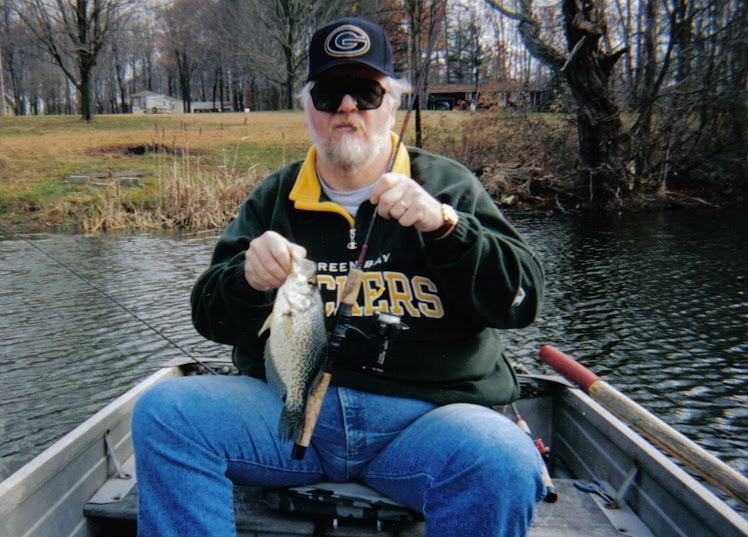
Me with a nice Black Crappie and Cigar
Late Summer Crappie
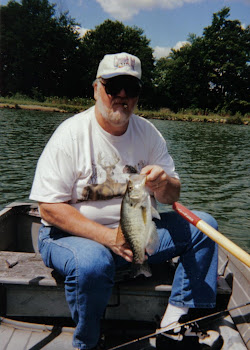
Me with a nice White crappie and Cigar
Tuesday, November 30, 2010
WINTER HARD WATER FISHING
Today is November 30, 2010. Although today's weather is above normal with rain, tomorrow is suppose to be near normal with snow showers. It's often said about the weather here in Ohio, "if you don't like the weather today, wait until tomorrow"! There has been some skim ice on the ponds already but it hasn't been cold enough to start a good ice over. I was checking the weather in Minnesota the other day and found the weather at Mille Lacs lake to be in the low twenties for day time highs and near "0" at night! This area usually ends up with over 3 foot of ice and their ice fishing season runs through March! If we get the right weather here in Ohio, I've seen our season run from mid January till mid February. It takes several nights with temperatures around zero to make good ice on our lakes. I refer to "Good Ice" as being hard and 6" or more in thickness! A rule of thumb states that 2" of ice can support one 200 pound man, 3" can support a small group that are spread out, 6" of hard ice will support a car. I mentioned "Hard Ice". If the freeze isn't interrupted by warming temperatures or rain and snow, the ice should form a hard, thick covering. If there is a period of snow during the freeze over, the ice will take on a cloudy, softer form and will require thicker ice to be safe! Personally, I never traverse on the ice until it is at least 5" thick. I'm a large guy at over 350 pounds and I don't like to take chances! When I think the time is right to check out the ice, I approach from the shallows, and using a spud bar, I attempt to see how solid the ice is by chopping small holes close to shore! If I'm happy with the results then I'll move further out and open another hole. I'll do this until I reach the first area I want to fish then I'll use my auger to open my fishing hole. I will use this method over the entire lake or at least the areas I will be fishing. The thickness of the ice can vary according to different underwater conditions or any structures like boat docks, rocks or wood that is protruding through the ice. These objects will draw heat from the sun and actually melt the ice that is surrounding them! You should never venture out on new ice alone. Keep in mind that the surface water is at 32 degrees and can be extremely life threating if you should break through! Ice fishing is a great sport and a fun way to make it through the long winter months. Use common sense, dress accordingly, have good equipment and you will find out just how much you will enjoy fishing through "Hard Water"!

Friday, November 19, 2010
THE LAST FISHING DAY OF 2010
Today was probably the last open water fishing day for 2010! We got out around 11a.m. and fished until 4p.m.. The day was sunny, breezy and COLD! The air temperature was 45 degrees, the wind out of the southwest at about 10 m.p.h. and the water temperature was around 43 degrees. Not the most perfect fishing day that we have enjoyed! We did, however, manage to catch 6 bass each for a total of 12 fish! My buddy caught all of his on spinners, using a C.P.Swing tipped with a yellow and white Uncle Josh Fly Strip and a chartreuse Rooster Tail. I used a black jig/plastic combo and a Smithwick Rogue jerk bait to lure my bass. The fish didn't seem to be on any pattern but were randomly scattered. Some came out of deep water while some came from the shallows. It was good to end the season on a high note since it's always good to catch bass and not get skunked on days like these! The small 12 foot boat is pulled from the water and turned over until spring, when we start the whole process over again! I've started making out my wish list for Christmas, wanting two new casting reels and rods to go with them, a new spinning outfit and maybe a new 9 foot fly rod with 7-8 weight line for bass fishing, plus several new fishing lures that are due out on the market soon! Over the winter, we will probably make a trip down to Wheeling, W.Va. to Cabala's and maybe one to Toledo, Ohio to Bass Pro Shops. I really need to get rid of some of my older tackle before I buy new but it is all like old friends to me and I don't know what to give up! It's hard for me to believe that my favorite casting rod is over 25 years old! We've had fun this fall with bass fishing and will be ready to get back to it come spring. I've yet to decide if ice fishing is in the cards, only time will tell! I'll let you all know so keep reading!
Friday, November 12, 2010
INDIAN SUMMER BASS
This week has been really beautiful here in Northeastern Ohio! The sun has been bright with temperatures in the low to mid 60's. While most folks are starting to think about the up coming holidays and trying to get all their last minute fall yard work done before the snows of December come, here we are, still catching Largemouth Bass! The weather these past two days (Nov.10 and 11) has been great and the fishing has been even better! The temperature has fell back into the low 30's at night but has rebounded into the low 60's during the day along with "Bluebird Skies"! My buddy and I have found some really good Bass this week. The one thing about fishing this time of year is when you find a fish you will find serveral in the same area! The weapons of choice has been Rapala Husky Jerks, Smithwick Rogues and CP Swings with a yellow and white Uncle Josh Fly Strip! The nice thing about using the smaller Husky Jerks is they can be worked really slow and since they are a suspending lure, they hover in the water when stopped! The water temperature was 46 degrees and the Bass didn't hit the baits very hard but instead would just "stop" the bait or hit while it was stopped and then it was the pure weight of the fish on the end of the line as they fought! Not keeping a count of the fish we caught, I would say in the two days we landed around 30 Bass, a dozen Bluegill and several "Jumbo" Yellow Perch that reached an amazing 12-14 inches in length! Being a small, private lake the only creatures we had to share the water with were about 180 Canadian Geese and 4-6 Mallard Ducks! It was very interesting to watch the geese as they kept their distance from us and at the approach of evening, they took off to find their supper. The geese were in the extreme upper end of the lake and reminded us of a squardron of aircraft when they took off! They divided into "Wings" of 6 groups and would swim into the middle of the upper end before going airborne. The group behind would wait until the group ahead was well into the air and clear of the take off area before they would jump off. The flights of geese were so perfectly timed with the lapse between flights that it made for very interesting viewing! It was two perfect days to be out on the water and with nature all around!
Saturday, October 23, 2010
CATCHING BASS ON A COLD AND WINDY OCTOBER DAY
Today is Saturday, October 23, 2010. My buddy Bill and I have spent the last two days on the lake in search of our favorite fish, Largemouth Bass. Yesterday started out very chilly with the temperature around 40 degrees at 10 o'clock in the morning. There was also a westerly breeze of between 10 and 15 mph. We got on the lake at 11 o'clock and fished until 5 o'clock in the afternoon. The fishing started out slow but picked up during the afternoon. We always say that we are going to count and keep track of the number of Bass we catch but never do! We found a good number of fish yesterday and the size was alittle above average which was a bonus! The Bass were hitting various lures from crank baits to spinner baits but for the most part they were caught on Rapalas and Smithwick Rogues. I thought the Bass would run into the shallows chasing the bait fish but they didn't.
Today's weather was an improvement from yesterday with the temperature getting into the low 60's but the wind was still there for a while and a heavy cloud cover moved in during the early afternoon. The fish weren't as agressive as yesterday but we still managed to catch our fair share. I also found some Black Crappie, Bluegill and serveral large Yellow Perch that would have made the perch fishermen of Lake Erie quite envious.
Today, we changed up our lure selection a little by using more straight in-line spinners which immitated small bait fish. We are hoping to give it another try next week and are starting to talk about taking a couple of trips next season and try our luck at other lakes. My mind actually started thinking about ice fishing which I haven't done in years. I'll have to tell you about some of those experience later on. If you can, leave me some comments or tails about your fall fishing. I can always talk fishing and enjoy hearing how other folks do it!
Today's weather was an improvement from yesterday with the temperature getting into the low 60's but the wind was still there for a while and a heavy cloud cover moved in during the early afternoon. The fish weren't as agressive as yesterday but we still managed to catch our fair share. I also found some Black Crappie, Bluegill and serveral large Yellow Perch that would have made the perch fishermen of Lake Erie quite envious.
Today, we changed up our lure selection a little by using more straight in-line spinners which immitated small bait fish. We are hoping to give it another try next week and are starting to talk about taking a couple of trips next season and try our luck at other lakes. My mind actually started thinking about ice fishing which I haven't done in years. I'll have to tell you about some of those experience later on. If you can, leave me some comments or tails about your fall fishing. I can always talk fishing and enjoy hearing how other folks do it!
Thursday, October 21, 2010
PICKING THE RIGHT TACKLE
These days, there is so much talk about picking the right fishing tackle, rods, reels, lines, baits,etc., that it can be quite confusing to the novice angler! If you ever watch some of the pro fishermen, they have so much tackle that I wonder how they keep from stepping all over it! You must kept in mind that since these people are pros they probably have all their tackle given to them, for endorsements and advertising purposes, from all the big name tackle manufacters.
For us every day anglers, things aren't always that easy for us to obtain the tackle that we would really like to have so, we must settle for less expensive rods and reels and instead of having a half dozen or more of each style rod, maybe we can only afford one or two!
By last count I had 4 casting reels and 6 casting rods, 6 spinning reels and 7 or 8 spinning rods, 4 fly rods and boxes full of lures, hooks and miscellaneous stuff and junk! Much of my tackle has seen better days and a couple of my outfits are over 40 years old! I'm not extremely protective of my things so I don't take very good care of my stuff. The simple fact that they are good pieces of equipment has allowed me to continue to use them today!
I haven't changed line on some of these reels for years, mainly due to the fact that there are only 3-4 outfits that I use on a regular basis. I do go over each and every outfit each spring and if I feel things need addressed, then at that time, I will do what is needed. Naturally, this is not the way to maintain your fishing tackle and I am advising you not to do what I do! You can look at the cost of tackle today as a major expense but one that will give you years of good service with the right up keep!
I look at new tackle every day, either by visits to the area stores or on-line, and I try to plan what I'm going to buy or replace next spring. I really need some new casting equipment since this is my primary rod and reel combination that I use for my Bass fishing. I want to purchase a 7 foot casting rod that has a fast to medium action and good for lure weights up to 3/4oz. I will team this with a high speed reel that has at least 6 ball bearings and 6.3:1 retrieve.
What I look for in new rods is #1) the feel of the rod. I don't want it to weight a ton because I might be casting this all day. #2) the recommended lure weights, which you will find on the lower end of the rod. #3) The action of the rod. A fast action rod will feel stiff through out the length of the rod with the exception of the rod tip. This will give the rod more backbone for horsing fish from cover. A medium action rod will have more of a bend from the tip into the mid portion of the rod. These will be better for crank baits fishing because of the give of the rod under the weight of a hooked fish. #4) I look at the number of guides on the rod. I actually think this may be the most important issue of all! The more the better and check to see the spacing of the guides are proportionally set down the length of the rod. Depending on a person's size should also be a key to determine the length of rod he or she will be comfortable using! A taller person will be more at ease casting a longer rod than someone with a shorter stature! The best length to start with is a 6 footer and work up from there. When a spinning rod is desired, all of the above should be taken into consideration. The average length of an all purpose spinning rod is a 6-7 foot rod. If an ultra light outfit is wanted, say to use for Bluegill and Crappie, a rod of light weight, limber body and length of 5-6 foot and a small reel with 4-6 pound test line is the way to go!
There are many styles and makes out there and everyone has their preference. I feel if my guide lines are considered, any rod will work just fine!
For us every day anglers, things aren't always that easy for us to obtain the tackle that we would really like to have so, we must settle for less expensive rods and reels and instead of having a half dozen or more of each style rod, maybe we can only afford one or two!
By last count I had 4 casting reels and 6 casting rods, 6 spinning reels and 7 or 8 spinning rods, 4 fly rods and boxes full of lures, hooks and miscellaneous stuff and junk! Much of my tackle has seen better days and a couple of my outfits are over 40 years old! I'm not extremely protective of my things so I don't take very good care of my stuff. The simple fact that they are good pieces of equipment has allowed me to continue to use them today!
I haven't changed line on some of these reels for years, mainly due to the fact that there are only 3-4 outfits that I use on a regular basis. I do go over each and every outfit each spring and if I feel things need addressed, then at that time, I will do what is needed. Naturally, this is not the way to maintain your fishing tackle and I am advising you not to do what I do! You can look at the cost of tackle today as a major expense but one that will give you years of good service with the right up keep!
I look at new tackle every day, either by visits to the area stores or on-line, and I try to plan what I'm going to buy or replace next spring. I really need some new casting equipment since this is my primary rod and reel combination that I use for my Bass fishing. I want to purchase a 7 foot casting rod that has a fast to medium action and good for lure weights up to 3/4oz. I will team this with a high speed reel that has at least 6 ball bearings and 6.3:1 retrieve.
What I look for in new rods is #1) the feel of the rod. I don't want it to weight a ton because I might be casting this all day. #2) the recommended lure weights, which you will find on the lower end of the rod. #3) The action of the rod. A fast action rod will feel stiff through out the length of the rod with the exception of the rod tip. This will give the rod more backbone for horsing fish from cover. A medium action rod will have more of a bend from the tip into the mid portion of the rod. These will be better for crank baits fishing because of the give of the rod under the weight of a hooked fish. #4) I look at the number of guides on the rod. I actually think this may be the most important issue of all! The more the better and check to see the spacing of the guides are proportionally set down the length of the rod. Depending on a person's size should also be a key to determine the length of rod he or she will be comfortable using! A taller person will be more at ease casting a longer rod than someone with a shorter stature! The best length to start with is a 6 footer and work up from there. When a spinning rod is desired, all of the above should be taken into consideration. The average length of an all purpose spinning rod is a 6-7 foot rod. If an ultra light outfit is wanted, say to use for Bluegill and Crappie, a rod of light weight, limber body and length of 5-6 foot and a small reel with 4-6 pound test line is the way to go!
There are many styles and makes out there and everyone has their preference. I feel if my guide lines are considered, any rod will work just fine!
Sunday, October 17, 2010
MY FAVORITE LAKE IN COLUMBIANA COUNTY
In my photos, the small lake that I am fishing is where I grew up. This is a 12-15 acre lake located in the north western portion of Columbiana County. I have been associated with this small body of water all of my life! My parents bought a partial of land here in 1947 for $500. Dad built our home on the property in 1961. Dad started fishing here in the mid 1940's and fell in love with the lake and decided to become an associate. The lake has always been private, open only to it's members however, during the 1960's it was opened for pay to fish to the public.
If I had a $1.00 for each fish I've caught out of this lake, I'd be a very wealthy man today! I've seldom gone there without catching fish and some of my friends, that have been with me, have said that this is the best water they have ever fished!
It was primarily a Largemouth Bass lake when Dad started fishing it but it also held Bluegill, Crappie, Perch, Catfish and a few Suckers (in the early days).
The lake is approximately over 170 years old, having been constructed as the result of the old Sandy and Beaver canal system that was attempted between 1835 and 1850. A branch of said canal runs northwest and southeast of the lake and the lake ( I believe) was constructed as a reservoir for the canal.
I would have loved to have been around at that time to have witnessed the construction. The lake has changed so much in my life time due to sediment filling in the shorelines. There used to be some major drop offs along the edges but the mud and muck has taken those away!
There used to be abundant lily pad growth and not much weeds but today it's just the opposite! The pads used to be so thick that half of the lake was covered with them and it looked like you could walk on them! The membership has always been fighting a never ending battle against the vegetation problems and today with the older members, I think it is a lost cause!
The majority of the members don't fish and cann't see the importance of a good lake management program! There are basically too many fish in the lake (since there are no fish being removed) and the size of the Bass have decreased through the years as a result! A thriving fish population is obtained through a good harvesting and catch and release program! For instance, if large Bass are the goal then the population of average size fish needs to be thinned out. The state of Ohio's D.N.R. recommends that 10 Bass under the length of 10 inches be removed per acre of fishing water plus one Bass of 15 inches every year. Then the primary food source, let's say Bluegill, should be reduced at the rate of 300 - 500 bluegill over the 6 inch size, per acre per year! This will allow the smaller Bluegill to be more readily available to be food fish for the Bass, allowing them to grow larger! That's a lot of fish for a 12 acre lake, especially when no one fishes the water!
Having said all the negative "stuff" about the lake, there is not a day that goes by that I don't want to be on that water! My buddy and I still manage to have a real good time and the Bass fishing is still good even if the fish are on the small side! I'm just as guilty for not taking fish but at the age of 60, I am just too lazy to clean them! We keep saying, "maybe today we will bring some home to eat", but never do!
If I had a $1.00 for each fish I've caught out of this lake, I'd be a very wealthy man today! I've seldom gone there without catching fish and some of my friends, that have been with me, have said that this is the best water they have ever fished!
It was primarily a Largemouth Bass lake when Dad started fishing it but it also held Bluegill, Crappie, Perch, Catfish and a few Suckers (in the early days).
The lake is approximately over 170 years old, having been constructed as the result of the old Sandy and Beaver canal system that was attempted between 1835 and 1850. A branch of said canal runs northwest and southeast of the lake and the lake ( I believe) was constructed as a reservoir for the canal.
I would have loved to have been around at that time to have witnessed the construction. The lake has changed so much in my life time due to sediment filling in the shorelines. There used to be some major drop offs along the edges but the mud and muck has taken those away!
There used to be abundant lily pad growth and not much weeds but today it's just the opposite! The pads used to be so thick that half of the lake was covered with them and it looked like you could walk on them! The membership has always been fighting a never ending battle against the vegetation problems and today with the older members, I think it is a lost cause!
The majority of the members don't fish and cann't see the importance of a good lake management program! There are basically too many fish in the lake (since there are no fish being removed) and the size of the Bass have decreased through the years as a result! A thriving fish population is obtained through a good harvesting and catch and release program! For instance, if large Bass are the goal then the population of average size fish needs to be thinned out. The state of Ohio's D.N.R. recommends that 10 Bass under the length of 10 inches be removed per acre of fishing water plus one Bass of 15 inches every year. Then the primary food source, let's say Bluegill, should be reduced at the rate of 300 - 500 bluegill over the 6 inch size, per acre per year! This will allow the smaller Bluegill to be more readily available to be food fish for the Bass, allowing them to grow larger! That's a lot of fish for a 12 acre lake, especially when no one fishes the water!
Having said all the negative "stuff" about the lake, there is not a day that goes by that I don't want to be on that water! My buddy and I still manage to have a real good time and the Bass fishing is still good even if the fish are on the small side! I'm just as guilty for not taking fish but at the age of 60, I am just too lazy to clean them! We keep saying, "maybe today we will bring some home to eat", but never do!
Friday, October 15, 2010
THE UNDERSTANDING AND USAGE OF SOLUNAR TABLES
The term "SOLUNAR" is the combination of the words "SOLAR" and "LUNAR" and the study of "SOLUNAR" deals with the effects on fish and wildlife that occur during different times of the day caused by the combined activities of the sun and the moon.
The study of the sun and moon and how their movements effect fish and wildlife has been on going for hundreds of years. The "NATIVE AMERICANS" depended on the harvest of fish and game for their survival and learned how important the solar and lunar influences were to the success of an adequate harvest of game.
It is a know fact that wildlife are more active during certain peaks of the solar and lunar movements and at different times of the day and night, most noticeably at dawn and dusk.
In 1926, John Alden Knight started research into the solunar activities and their effect on wildlife. His research resulted in a publication of tables which showed periods of "Major" and "Minor" activities. During Knight's study, data was analyzed pertaining to over 200 record catches of fish. The analysis showed that 90% of the catches were made under the effect of the "NEW MOON" and while in a solunar period.
More studies were done at Northwestern University, by Dr. Frank A Brown, using live oysters that he had brought to his lab in Chicago, Illinois. Oysters open their shells at each "High Tide" and tides are controled by lunar influence. Dr. Brown discovered that the oysters opened their shells corresponding to the times that the moon was directly "overhead" and "underfoot" for Chicago.
Solunar tables have been in use since 1936. These tables show the time frame when "Major" and "Minor" periods of solar and lunar activities occur and gives windows into periods of significant increase in wildlife activities.
The terms "MAJOR" and "MINOR" are related to the position of the moon. The Majors occur when the moon is directly overhead and directly underfoot (on the opposite side of the earth). The Minors are when the moon is half way between the overhead and underfoot positions. There are two Majors and two Minors in every 24 hour period. These periods are predicted to be when fish and wildlife are most active.
If possible, try to schedule your fishing and hunting periods within the major and minor periods of the day or night for a greater success of your outting.
The facts and figures of this article were published through the Weather Channel.
The study of the sun and moon and how their movements effect fish and wildlife has been on going for hundreds of years. The "NATIVE AMERICANS" depended on the harvest of fish and game for their survival and learned how important the solar and lunar influences were to the success of an adequate harvest of game.
It is a know fact that wildlife are more active during certain peaks of the solar and lunar movements and at different times of the day and night, most noticeably at dawn and dusk.
In 1926, John Alden Knight started research into the solunar activities and their effect on wildlife. His research resulted in a publication of tables which showed periods of "Major" and "Minor" activities. During Knight's study, data was analyzed pertaining to over 200 record catches of fish. The analysis showed that 90% of the catches were made under the effect of the "NEW MOON" and while in a solunar period.
More studies were done at Northwestern University, by Dr. Frank A Brown, using live oysters that he had brought to his lab in Chicago, Illinois. Oysters open their shells at each "High Tide" and tides are controled by lunar influence. Dr. Brown discovered that the oysters opened their shells corresponding to the times that the moon was directly "overhead" and "underfoot" for Chicago.
Solunar tables have been in use since 1936. These tables show the time frame when "Major" and "Minor" periods of solar and lunar activities occur and gives windows into periods of significant increase in wildlife activities.
The terms "MAJOR" and "MINOR" are related to the position of the moon. The Majors occur when the moon is directly overhead and directly underfoot (on the opposite side of the earth). The Minors are when the moon is half way between the overhead and underfoot positions. There are two Majors and two Minors in every 24 hour period. These periods are predicted to be when fish and wildlife are most active.
If possible, try to schedule your fishing and hunting periods within the major and minor periods of the day or night for a greater success of your outting.
The facts and figures of this article were published through the Weather Channel.
Subscribe to:
Posts (Atom)